
Written by the Doctobip Editorial Team. Educational information only — not medical advice. See our Medical Disclaimer.
If you’re asking what is a cgm, you’re in the right place. This guide gives you a clear, practical answer and the key facts that matter most, so you can understand your options and act with confidence — in plain, everyday language, without the jargon.
Continuous glucose monitors (CGMs) have transformed diabetes care. Instead of a single fingerstick reading, a CGM shows where your glucose is, where it’s heading, and how fast — around the clock. Here’s how they work and who benefits.
What is a CGM?
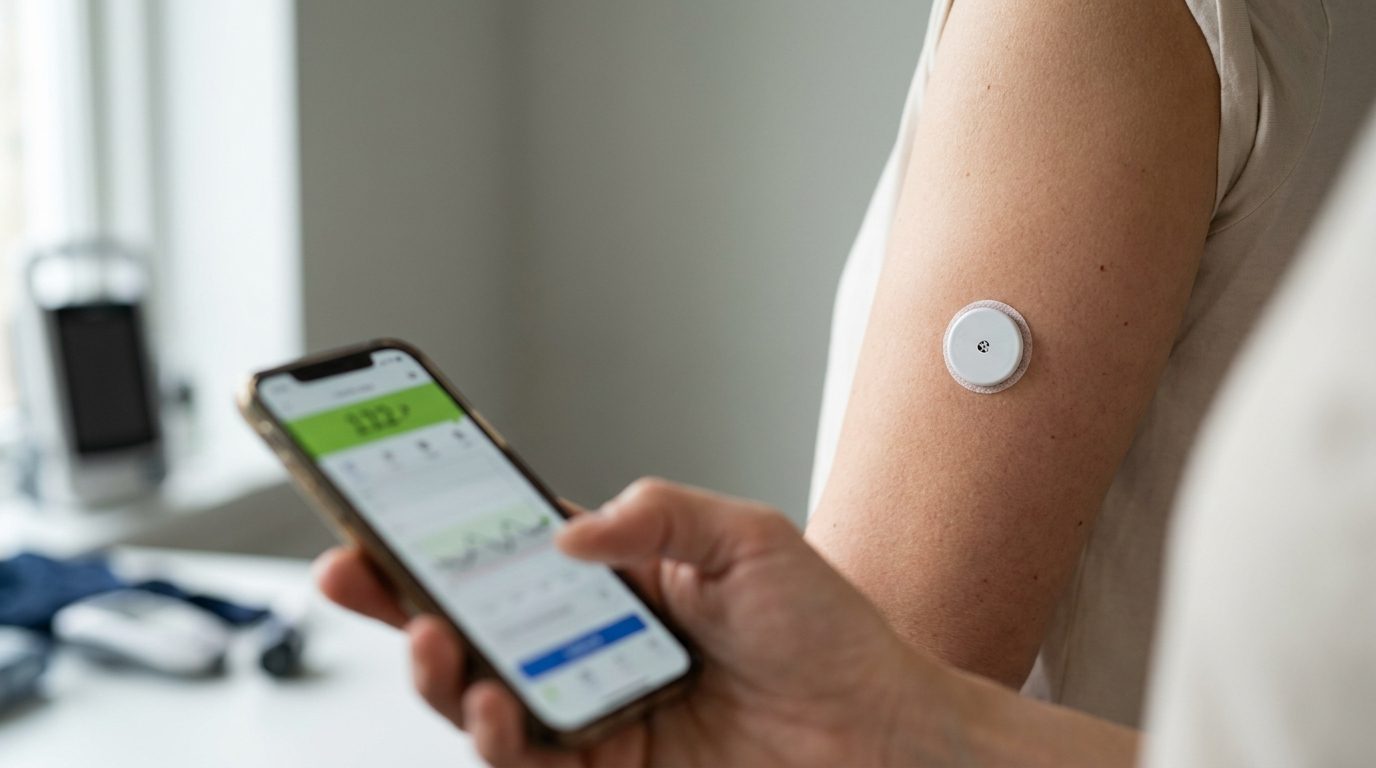
A CGM is a small wearable sensor, usually placed on the upper arm or abdomen, with a tiny filament just under the skin. It measures glucose in the fluid between cells (interstitial fluid) every few minutes and sends readings to a phone app or receiver. Sensors typically last 10–15 days before being replaced.
CGM vs fingerstick meter
- Meter: a snapshot — accurate, but only at the moment you test. See our glucose meter buying guide.
- CGM: a movie — hundreds of readings a day, trend arrows, and alarms for highs and lows (including while you sleep).
Note: CGM readings lag blood glucose by a few minutes, especially during rapid changes — which is why fingersticks are still sometimes used to confirm.
Who benefits most?
- People with type 1 diabetes: CGM is now standard of care for most — it reduces hypoglycemia and improves time in range
- People with type 2 on insulin: strong evidence of benefit; increasingly covered by insurance
- Others with type 2 or prediabetes: can be a powerful learning tool (seeing how meals, walks and sleep affect glucose), though coverage varies
What the numbers mean: time in range
CGMs popularized a helpful metric: time in range — the share of the day spent between 70 and 180 mg/dL. Many care teams aim for over 70% in range, with minimal time below 70. It complements A1C by revealing the highs and lows an average can hide.
The main systems
The established CGM families come from Abbott (FreeStyle Libre), Dexcom, and Medtronic, with newer options entering the market — including over-the-counter sensors in the US aimed at people not using insulin. Features, phone compatibility and insurance coverage differ, so compare current models with your care team.
- A CGM shows continuous glucose readings plus trend arrows and alerts.
- It’s standard of care in type 1 and increasingly used in type 2.
- “Time in range” (70–180 mg/dL) is the key CGM metric.
- Sensors last ~10–15 days; readings slightly lag blood glucose.
Frequently asked questions
Does applying a sensor hurt?
Most people feel little or nothing — the filament is very fine and applicators do the work in a second.
Can I shower or swim with a CGM?
Sensors are water-resistant within limits set by each manufacturer — brief showers and swims are generally fine.
Do CGMs replace fingersticks completely?
Mostly, for many users — but confirmation fingersticks are still advised in specific situations (symptoms that don’t match readings, rapid changes, some devices’ calibration).
References
- American Diabetes Association — Standards of Care (CGM)
- NIDDK — Continuous Glucose Monitoring
- U.S. FDA — Glucose monitoring devices
What is a CGM? Putting it into practice
Once you know what is a CGM, the next step is using it well. Understanding what is a CGM helps you spot patterns early, and the more you revisit what is a CGM, the clearer it becomes. Your care team can also explain what is a CGM in the context of your own health and goals.
What Is a CGM: The Bottom Line
The best outcomes rarely come from dramatic overhauls — they come from small, consistent habits you can actually keep. Start by understanding what your key numbers mean, then agree on realistic targets that fit your daily life together with your care team. Keep a simple record of what you eat, how you move and how you feel, so patterns become clear and you can repeat what works. Prepare for the tricky moments in advance, and give yourself credit for steady progress rather than perfection. Above all, if something feels off or you are unsure, do not guess — reach out to a qualified healthcare professional. With reliable information and a routine that suits you, staying in control becomes far more manageable.
Helpful links
Medical disclaimer: This article is for general education and is not a substitute for professional medical advice. Discuss monitoring choices with your healthcare provider.